
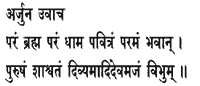
Arjuna said: Thou art the supreme Brahman, the supreme Abode, the supreme Purity, the one permanent, the divine Purusha, the original Godhead, the Unborn, the all-pervading Lord.
Towards the Supreme Secret
Sri Aurobindo
THE TEACHER has completed all else that he needed to say, he has worked out all the central principles and the supporting suggestions and implications of his message and elucidated the principal doubts and questions that might rise around it, and now all that rests for him to do is to put into decisive phrase and penetrating formula the one last word, the heart itself of the message, the very core of his gospel. And we find that this decisive, last and crowning word is not merely the essence of what has been already said on the matter, not merely a concentrated description of the needed self-discipline, the Sadhana, and of that greater spiritual consciousness which is to be the result of all its effort and askesis; it sweeps out, as it were, yet farther, breaks down every limit and rule, canon and formula and opens into a wide and illimitable spiritual truth with an infinite potentiality of significance. And that is a sign of the profundity, the wide reach, the greatness of spirit of the Gita’s teaching. An ordinary religious teaching or philosophical doctrine is well enough satisfied to seize on certain great and vital aspects of truth and turn them into utilisable dogma and instruction, method and practice for the guidance of man in his inner life and the law and form of his action; it does not go farther, it does not open doors out of the circle of its own system, does not lead us out into some widest freedom and unimprisoned largeness. This limitation is useful and indeed for a time indispensable. Man bounded by his mind and will has need of a law and rule, a fixed system, a definite practice selective of his thought and action; he asks for the single unmistakable hewn path hedged, fixed and secure to the tread, for the limited horizons, for the enclosed resting-places. It is only the strong
and few who can move through freedom to freedom. And yet in the end the free soul ought to have an issue out of the forms and systems in which the mind finds its account and takes its limited pleasure. To exceed our ladder of ascent, not to stop short even on the topmost stair but move untrammelled and at large in the wideness of the spirit is a release important for our perfection; the spirit’s absolute liberty is our perfect status. And this is how the Gita leads us: it lays down a firm and sure but very large way of ascent, a great Dharma, and then it takes us out beyond all that is laid down, beyond all dharmas, into infinitely open spaces, divulges to us the hope, lets us into the secret of an absolute perfection founded in an absolute spiritual liberty, and that secret, guhyatamam, is the substance of what it calls its supreme word, that the hidden thing, the inmost knowledge. And first the Gita restates the body of its message. It summarises the whole outline and essence in the short space of fifteen verses, lines of a brief and concentrated expression and significance that miss nothing of the kernel of the matter, couched in phrases of the most lucid precision and clearness. And they must therefore be scanned with care, must be read deeply in the light of all that has gone before, because here it is evidently intended to extract what the Gita itself considers to be the central sense of its own teaching. The statement sets out from the original starting-point of the thought in the book, the enigma of human action, the apparently insuperable difficulty of living in the highest self and spirit while yet we continue to do the works of the world. The easiest way is to give up the problem as insoluble, life and action as an illusion or an inferior movement of existence to be abandoned as soon as we can rise out of the snare of the world into the truth of spiritual being. That is the ascetic solution, if it can be called a solution; at any rate it is a decisive and effective way out of the enigma, a way to which ancient Indian thought of the highest and most meditative kind, as soon as it commenced to turn at a sharp incline from its first large and free synthesis, had moved with an always increasing preponderance. The Gita like the Tantra and on certain sides the later religions attempts to preserve the ancient balance: it maintains the substance and foundation of the original synthesis, but the form has been changed and renovated in the light of a developing spiritual experience. This teaching does not evade the difficult problem of reconciling the full active life of man with the inner life in the highest self and spirit; it advances what it holds to be the real solution. It does not at all deny the efficacy of the ascetic renunciation of life for its own purpose, but it sees that that cuts instead of loosening the knot of the riddle and therefore it accounts it an inferior method and holds its own for the better way. The two paths both lead us out of the lower ignorant normal nature of man to the pure spiritual consciousness and so far both must be held to be valid and even one in essence: but where one stops short and turns back, the other advances with a firm subtlety and high courage, opens a gate on unexplored vistas, completes man in God and unites and reconciles in the spirit soul and Nature. And therefore in the first five of these verses the Gita so phrases its statement that it shall be applicable to both the way of the inner and theway of the outer renunciation and yet in such a manner that one has only to assign to some of their common expressions a deeper and more inward meaning in order to get the sense and thought of the method favoured by the Gita. The difficulty of human action is that the soul and nature of man seem fatally subjected to many kinds of bondage, the prison of the ignorance, the meshes of the ego, the chain of the passions, the hammering insistence of the life of the moment, an obscure and limited circle without an issue. The soul shut up in this circle of action has no freedom, no leisure or light of self-knowledge to make the discovery of its self and the true value of life and meaning of existence. It has indeed such hints of its being as it can get from its active personality and dynamic nature, but the standards of perfection it can erect there are much too temporal, restricted and relative to be a satisfactory key to its own riddle. How, while absorbed and continually forced outward by the engrossing call of its active nature, is it to get back to its real self and spiritual existence? The ascetic renunciation and the way of the Gita are both agreed that it must first of all renounce this absorption, must cast from it the external solicitation of outward things and separate silent self from active nature; it must identify itself with the immobile Spirit and live in the silence. It must arrive at an inner inactivity, nais.karmya. It is therefore this saving inner passivity that the Gita puts here as the first object of its Yoga, the first necessary perfection in it or Siddhi. “An understanding without attachment in all things, a soul selfconquered and empty of desire, man attains by renunciation a supreme perfection of nais.karmya.” This ideal of renunciation, of a self-conquered stillness, spiritual passivity and freedom from desire is common to all the ancient wisdom. The Gita gives us its psychological foundation with an unsurpassed completeness and clearness. It rests on the common experience of all seekers of self-knowledge that there are two different natures and as it were two selves in us. There is the lower self of the obscure mental, vital and physical nature subject to ignorance and inertia in the very stuff of its consciousness and especially in its basis of material substance, kinetic and vital indeed by the power of life but without inherent selfpossession and self-knowledge in its action, attaining in the mind to some knowledge and harmony, but only with difficult effort and by a constant struggle with its own disabilities. And there is the higher nature and self of our spiritual being, self-possessed and self-luminous but in our ordinary mentality inaccessible to our experience. At times we get glimpses of this greater thing within us, but we are not consciously within it, we do not live in its light and calm and illimitable splendour. The first of these two very different things is the Gita’s nature of the three gunas. Its seeing of itself is centred in the ego idea, its principle of action is desire born of ego, and the knot of ego is attachment to the objects of the mind and sense and the life’s desire. The inevitable constant result of all these things is bondage, settled subjection to a lower control, absence of self-mastery, absence of selfknowledge. The other greater power and presence is discovered to be nature and being of the pure spirit unconditioned by ego, that which is called in Indian philosophy self and impersonal Brahman. Its principle is an infinite and an impersonal existence one and the same in all: and, since this impersonal existence is without ego, without conditioning quality, without desire, need or stimulus, it is immobile and immutable; eternally the same, it regards and supports but does not share or initiate the action of the universe. The soul when it throws itself out into active Nature is the Gita’s Kshara, its mobile or mutable Purusha; the same soul gathered back into pure silent self and essential spirit is the Gita’s Akshara, immobile or immutable Purusha. Then evidently the straight and simplest way to get out of the close bondage of the active nature and back to spiritual freedom is to cast away entirely all that belongs to the dynamics of the ignorance and to convert the soul into a pure spiritual existence. That is what is called becoming Brahman, brahmabhu ¯ ya. It is to put off the lower mental, vital, physical existence and to put on the pure spiritual being. This can best be done by the intelligence and will, buddhi, our present topmost principle. It has to turn away from the things of the lower existence and first and foremost from its effective knot of desire, from our attachment to the objects pursued by the mind and the senses. One must become an understanding unattached in all things, asakta-buddhih. sarvatra. Then all desire passes away from the soul in its silence; it is free from all longings, vigata-spr.hah.. That brings with it or it makes possible the subjection of our lower and the possession of our higher self, a possession dependent on complete self-mastery, secured by a radical victory and conquest over our mobile nature, jit ¯atm¯a. And all this amounts to an absolute inner renunciation of the desire of things, sanny¯asa. Renunciation is the way to this perfection and the man who has thus inwardly renounced all is described by the Gita as the true Sannyasin. But because the word usually signifies as well an outward renunciation or sometimes even that alone, the Teacher uses another word, ty ¯aga, to distinguish the inward from the outward withdrawal and says that Tyaga is better than Sannyasa. The ascetic way goes much farther in its recoil from the dynamic Nature. It is enamoured of renunciation for its own sake and insists on an outward giving up of life and action, a complete quietism of soul and nature. That, the Gita replies, is not possible entirely so long as we live in the body. As far as it is possible, it may be done, but such a rigorous diminution of works is not indispensable: it is not even really or at least ordinarily advisable. The one thing needed is a complete inner quietism and that is all the Gita’s sense of nais.karmya. If we ask why this reservation, why this indulgence to the dynamic principle when our object is to become the pure self and the pure self is described as inactive, akart¯a, the answer is that that inactivity and divorce of self from Nature are not the whole truth of our spiritual release. Self and Nature are in the end one thing; a total and perfect spirituality makes us one with all the Divine in self and in nature. In fact this becoming Brahman, this assumption into the self of eternal silence, brahma-bhu¯ ya, is not all our objective, but only the necessary immense base for a still greater and more marvellous divine becoming, madbh ¯ava. And to get to that greatest spiritual perfection we have indeed to be immobile in the self, silent in all our members, but also to act in the power, Shakti, Prakriti, the true and high force of the Spirit. And if we ask how a simultaneity of what seem to be two opposites is possible, the answer is that that is the very nature of a complete spiritual being; always it has this double poise of the Infinite. The impersonal self is silent; we too must be inwardly silent, impersonal, withdrawn into the spirit. The impersonal self looks on all action as done not by it but by Prakriti; it regards with a pure equality all the working of her qualities, modes and forces: the soul impersonalised in the self must similarly regard all our actions as done not by itself but by the qualities of Prakriti; it must be equal in all things, sarvatra. And at the same time in order that we may not stop here, in order that we may eventually go forward and find a spiritual rule and direction in our works and not only a law of inner immobility and silence, we are asked to impose on the intelligence and will the attitude of sacrifice, all our action inwardly changed and turned into an offering to the Lord ofNature, to the Being of whom she is the self-power, sv¯a prakr. tih. , the supreme Spirit. Even we have eventually to renounce all into his hands, to abandon all personal initiation of action, sarv ¯arambh¯ah., to keep our natural selves only as an instrument of his works and his purpose. These things have been already explained fully and the Gita does not here insist, but uses simply without farther qualification the common terms, sanny¯asa and nais.karmya. A completest inner quietism once admitted as our necessary means towards living in the pure impersonal self, the question how practically it brings about that result is the next issue that arises. “How, having attained this perfection, one thus attains to the Brahman, hear from me, O son of Kunti,—that which is the supreme concentrated direction of the knowledge.” The knowledge meant here is the Yoga of the Sankhyas,—the Yoga of pure knowledge accepted by the Gita, jn˜ a¯na-yogena sa¯n˙khya¯na¯m, so far as it is one with its own Yoga which includes also the way of works of the Yogins, karma-yogena yogin¯am. But all mention of works is kept back for the moment. For by Brahman here is meant at first the silent, the impersonal, the immutable. The Brahman indeed is both for the Upanishads and the Gita all that is and lives and moves; it is not solely an impersonal Infinite or an unthinkable and incommunicable Absolute, acintyam avyavah¯aryam. All this is Brahman, says the Upanishad; all this is Vasudeva, says the Gita,—the supreme Brahman is all that moves or is stable and his hands and feet and eyes and heads and faces are on every side of us. But still there are two aspects of this All,—his immutable eternal self that supports existence and his self of active power that moves abroad in the world movement. It is only when we lose our limited ego personality in the impersonality of the self that we arrive at the calm and free oneness by which we can possess a true unity with the universal power of the Divine in his world movement. Impersonality is a denial of limitation and division, and the cult of impersonality is a natural condition of true being, an indispensable preliminary of true knowledge and therefore a first requisite of true action. It is very clear that we cannot become one self with all or one with the universal Spirit and his vast self-knowledge, his complex will and his widespread world-purpose by insisting on our limited personality of ego; for that divides us from others and it makes us bound and self-centred in our view and in our will to action. Imprisoned in personality we can only get at a limited union by sympathy or by some relative accommodation of ourselves to the view-point and feeling and will of others. To be one with all and with the Divine and his will in the cosmos we must become at first impersonal and free from our ego and its claims and from the ego’s way of seeing ourselves and the world and others. And we cannot do this if there is not something in our being other than the personality, other than the ego, an impersonal self one with all existences. To lose ego and be this impersonal self, to become this impersonal Brahman in our consciousness is therefore the first movement of this Yoga. How then is this to be done? First, says the Gita, through a union of our purified intelligence with the pure spiritual substance in us by the yoga of the buddhi, buddhy¯a vi´suddhay¯a yuktah. . This spiritual turning of the buddhi from the outward and downward to the inward and upward look is the essence of the Yoga of knowledge. The purified understanding has to control the whole being, a¯tma¯nam˙ niyamya; it must draw us away from attachment to the outward-going desires of the lower nature by a firm and a steady will, dhr.ty ¯a, which in its concentration faces entirely towards the impersonality of the pure spirit. The senses must abandon their objects, themind must cast away the liking and disliking which these objects excite in it,— for the impersonal self has no desires and repulsions; these are vital reactions of our personality to the touches of things and the corresponding response of the mind and senses to the touches is their support and their basis. An entire control has to be acquired over the mind, speech and body, over even the vital and physical reactions, hunger and cold and heat and physical pleasure and pain; the whole of our being must become indifferent, unaffected by these things, equal to all outward touches and to their inward reactions and responses. This is the most direct and powerful method, the straight and sharp way of Yoga. There has to be a complete cessation of desire and attachment, vair ¯agya; a strong resort to impersonal solitude, a constant union with the inmost self by meditation is demanded of the seeker. And yet the object of this austere discipline is not to be self-centred in some supreme egoistic seclusion and tranquillity of the sage and thinker averse to the trouble of participation in the world-action; the object is to get rid of all ego. One must put away utterly first the rajasic kind of egoism, egoistic strength and violence, arrogance, desire, wrath, the sense and instinct of possession, the urge of the passions, the strong lusts of life. But afterwards must be discarded egoism of all kinds, even of the most sattwic type; for the aim is to make soul and mind and life free in the end from all imprisoning I-ness and my-ness, nirmama. The extinction of ego and its demands of all sorts is the method put before us. For the pure impersonal self which, unshaken, supports the universe has no egoism and makes no demand on thing or person; it is calm and luminously impassive and silently regards all things and persons with an equal and impartial eye of self-knowledge and world-knowledge. Then clearly it is by living inwardly in a similar or identical impersonality that the soul within, released from the siege of things, can best become capable of oneness with this immutable Brahman which regards and knows but is not affected by the forms and mutations of the universe. This first pursuit of impersonality as enjoined by the Gita brings with it evidently a certain completest inner quietism and is identical in its inmost parts and principles of practice with the method of Sannyasa. And yet there is a point at which its tendency of withdrawal from the claims of dynamic Nature and the external world is checked and a limit imposed to prevent the inner quietism from deepening into refusal of action and a physical withdrawal. The renunciation of their objects by the senses, vis.aya¯m˙ s tyaktva¯ , is to be of the nature of Tyaga; it must be a giving up of all sensuous attachment, rasa, not a refusal of the intrinsic necessary activity of the senses. One must move among surrounding things and act on the objects of the sense-field with a pure, true and intense, a simple and absolute operation of the senses for their utility to the spirit in divine action, kevalair indriyai´s caran, and not at all for the fulfilment of desire. There is to be vair ¯agya, not in the common significance of disgust of life or distaste for the world action, but renunciation of r ¯aga, as also of its opposite, dves.a. There must be a withdrawal from all mental and vital liking as from all mental and vital disliking whatsoever. And this is asked not for extinction, but in order that there may be a perfect enabling equality in which the spirit can give an unhampered and unlimited assent to the integral and comprehensive divine vision of things and to the integral divine action inNature.Acontinual resort to meditation, dhy¯ana-yogaparo nityam, is the firm means by which the soul of man can realise its self of Power and its self of silence. And yet there must be no abandonment of the active life for a life of puremeditation; action must always be done as a sacrifice to the supreme Spirit. This movement of recoil in the path of Sannyasa prepares an absorbed disappearance of the individual in the Eternal, and renunciation of action and life in the world is an indispensable step in the process. But in the Gita’s path of Tyaga it is a preparation rather for the turning of our whole life and existence and of all action into an integral oneness with the serene and immeasurable being, consciousness and will of the Divine, and it preludes and makes possible a vast and total passing upward of the soul out of the lower ego to the inexpressible perfection of the supreme spiritual nature, par¯a prakr. ti. This decisive departure of the Gita’s thought is indicated in the next two verses, of which the first runs with a significant sequence, “When one has become the Brahman, when one neither grieves nor desires, when one is equal to all beings, then one gets the supreme love and devotion to Me.” But in the narrow path of knowledge bhakti, devotion to the personal Godhead, can be only an inferior and preliminary movement; the end, the climax is the disappearance of personality in a featureless oneness with the impersonal Brahman in which there can be no place for bhakti: for there is none to be adored and none to adore; all else is lost in the silent immobile identity of the Jiva with the Atman. Here there is given to us something yet higher than the Impersonal,—here there is the supreme Self who is the supreme Ishwara, here there is the supreme Soul and its supreme nature, here there is the Purushottama who is beyond the personal and impersonal and reconciles them on his eternal heights. The ego personality still disappears in the silence of the Impersonal, but at the same time there remains even with this silence at the back the action of a supreme Self, one greater than the Impersonal. There is no longer the lower blind and limping action of the ego and the three gunas, but instead the vast self-determining movement of an infinite spiritual Force, a free immeasurable Shakti. All Nature becomes the power of the one Divine and all action his action through the individual as channel and instrument. In place of the ego there comes forward conscious and manifest the true spiritual individual in the freedom of his real nature, in the power of his supernal status, in the majesty and splendour of his eternal kinship to the Divine, an imperishable portion of the supreme Godhead, an indestructible power of the supreme Prakriti, mamaiv¯a ˙ m´sah. san¯atanah. , par¯a prakr. tir jı¯va-bhu¯ ta¯. The soul of man then feels itself to be one in a supreme spiritual impersonality with the Purushottama and in its universalised personality a manifest power of the Godhead. Its knowledge is a light of his knowledge; its will is a force of his will; its unity with all in the universe is a play of his eternal oneness. It is in this double realisation, it is in this union of two sides of an ineffable Truth of existence by either and both of which man can approach and enter into his own infinite being, that the liberated man has to live and act and feel and determine or rather have determined for him by a greatest power of his supreme self his relations with all and the inner and outer workings of his spirit. And in that unifying realisation adoration, love and devotion are not only still possible, but are a large, an inevitable and a crowning portion of the highest experience. The One who eternally becomes the Many, the Many who in their apparent division are still eternally one, the Highest who displays in us this secret and mystery of existence, not dispersed by his multiplicity, not limited by his oneness,—this is the integral knowledge, this is the reconciling experience which makes one capable of liberated action, muktasya karma. This knowledge comes, says the Gita, by a highest bhakti. It is attained when the mind exceeds itself by a supramental and high spiritual seeing of things and when the heart too rises in unison beyond our more ignorant mental forms of love and devotion to a love that is calm and deep and luminous with widest knowledge, to a supreme delight in God and an illimitable adoration, the unperturbed ecstasy, the spiritual Ananda. When the soul has lost its separative personality, when it has become the Brahman, it is then that it can live in the true Person and can attain to the supreme revealing bhakti for the Purushottama and can come to know him utterly by the power of its profound bhakti, its heart’s knowledge, bhakty¯a m¯am abhij ¯an¯ ati. That is the integral knowledge, when the heart’s fathomless vision completes the mind’s absolute experience,—samagram˙ ma¯m˙ jn˜ a¯tva¯ . “He comes to know Me,” says the Gita, “who and how much I am and in all the reality and principles of my being, y¯av¯an ya´s c ¯asmi tattvatah. .” This integral knowledge is the knowledge of the Divine present in the individual; it is the entire experience of the Lord secret in the heart of man, revealed now as the supreme Self of his existence, the Sun of all his illumined consciousness, theMaster and Power of all his works, the divine Fountain of all his soul’s love and delight, the Lover and Beloved of his worship and adoration. It is the knowledge too of the Divine extended in the universe, of the Eternal from whom all proceeds and in whom all lives and has its being, of the Self and Spirit of the cosmos, of Vasudeva who has become all this that is, of the Lord of cosmic existence who reigns over the works of Nature. It is the knowledge of the divine Purusha luminous in his transcendent eternity, the form of whose being escapes from the thought of the mind but not from its silence; it is the entire living experience of him as absolute Self, supreme Brahman, supreme Soul, supreme Godhead: for that seemingly incommunicable Absolute is at the same time and even in that highest status the originating Spirit of the cosmic action and Lord of all these existences. The soul of the liberated man thus enters by a reconciling knowledge, penetrates by a perfect simultaneous delight of the transcendent Divine, of the Divine in the individual and of the Divine in the universe into the Purushottama, ma¯m˙ vis´ate tadanantaram. He becomes one with him in his self-knowledge and self-experience, one with him in his being and consciousness and will and worldknowledge and world-impulse, one with him in the universe and in his unity with all creatures in the universe and one with him beyond world and individual in the transcendence of the eternal Infinite, s´a¯s´vatam˙ padam avyayam. This is the culmination of the supreme bhakti that is at the core of the supreme knowledge. And it then becomes evident how action continual and unceasing and of all kinds without diminution or abandonment of any part of the activities of life can be not only quite consistent with a supreme spiritual experience, but as forceful a means of reaching this highest spiritual condition as bhakti or knowledge. Nothing can be more positive than the Gita’s statement in this matter. “And by doing also all actions always lodged in Me he attains by my grace the eternal and imperishable status.” This liberating action is of the character of works done in a profound union of the will and all the dynamic parts of our nature with the Divine in ourself and the cosmos. It is done first as a sacrifice with the idea still of our self as the doer. It is done next without that idea and with a perception of the Prakriti as the sole doer. It is done last with the knowledge of that Prakriti as the supreme power of the Divine and a renunciation, a surrender of all our actions to him with the individual as a channel only and an instrument. Our works then proceed straight from the Self and Divine within us, are a part of the indivisible universal action, are initiated and performed not by us but by a vast transcendent Shakti. All that we do is done for the sake of the Lord seated in the heart of all, for the Godhead in the individual and for the fulfilment of his will in us, for the sake of the Divine in the world, for the good of all beings, for the fulfilment of the world action and the world purpose, or in one word for the sake of the Purushottama and done really by him through his universal Shakti. These divine works, whatever their form or outward character, cannot bind, but are rather a potent means for rising out of this lower Prakriti of the three gunas to the perfection of the supreme, divine and spiritual nature. Disengaged from these mixed and limited dharmas we escape into the immortal Dharma which comes upon us when we make ourselves one in all our consciousness and action with the Purushottama. That oneness here brings with it the power to rise there into the immortality beyond Time. There we shall exist in his eternal transcendence. Thus these eight verses carefully read in the light of the knowledge already given by the Teacher are a brief, but still a comprehensive indication of the whole essential idea, the entire central method, all the kernel of the complete Yoga of the Gita.
Sri Aurobindo
 About Us | ©1999 - 2009 searchforlight.org
All extracts and quotations from the written works of Sri Aurobindo and the Mother and the Photographs of
the Mother and Sri Aurobindo are copyright Sri Aurobindo Ashram Trust, Pondicherry -605002 India.